

É A PRIMEIRA VEZ?
Assine nossa newsletter e seja o primeiro a saber sobre nossas novidades, promoções especiais e exclusividades online.
Rugged smartwatches have moved well beyond “tough-looking” fashion statements — they’re now serious tools for outdoorspeople, first responders, and anyone who expects a wearable to survive real use. In 2025 the market is crowded: you’ve got wrist computers built for week-long treks, compact multisport devices with advanced sensors, and value-focused models that aim to do “enough” very reliably.
This comparison puts the AuraFit Trek 1 head-to-head with a few notable rivals (AuraFit Trek 2, ENERGY3, and NEXA 4). We’ll give a quick verdict, a clear specs table, real-world testing notes (hiking, rainy days, and city life), battery and charging analysis, plus value and warranty thoughts — finishing with top-pick recommendations so you can choose without second-guessing.
The AuraFit Trek 1 is perfect for:
The Value-Conscious Adventurer: You want premium rugged features without a premium price tag. The Trek 1 offers an incredible balance of performance and cost.
The Weekend Warrior: Your adventures are regular—weekend hikes, trail runs, and camping trips—but not week-long, off-grid expeditions requiring solar charging.
First-Time Rugged Watch Buyers: If you're moving from a standard fitness tracker or smartwatch into the rugged category, the Trek 1 provides a user-friendly interface and core features without overwhelming complexity.
Urban Professionals with an Active Side: You need a watch that can survive a commute, a workout, and a surprise downpour, yet still look sleek enough for daily wear.
The AuraFit Trek 1 might NOT be for you if:
You're an Extreme Endurance Athlete: If you need multi-week battery life with solar charging and specialized mountaineering metrics, the more advanced AuraFit Trek 2 or ENERGY3 are better suited.
You Demand the Absolute Best Screen: While bright and sharp, the Trek 1’s display is slightly outperformed by the sapphire crystal and higher-nit screen on the NEXA 4.
Your Priority is High-Intensity Smart Features: The Trek 1 focuses on core health and navigation. If you need full-on smartphone app integration and LTE calling, the NEXA 4 is a stronger contender.
Short version: the Trek 1 is a hardworking, no-nonsense rugged watch — excellent for outdoor reliability and value — but not targeted at buyers chasing every pro-level sensor or smartwatch frill.
|
Feature |
AuraFit Trek 1 |
AuraFit Trek 2 |
ENERGY3 |
NEXA 4 |
|
GPS |
Multi-band + Galileo |
/ |
/ |
|
|
Battery (typical) |
14–21 days (mixed use) |
21–28 days |
10–14 days |
10–14 days |
|
Fast charge |
2-3H |
2-3H |
2-3H |
2-3H |
|
Water rating |
5 ATM |
3 ATM |
1 ATM |
1 ATM |
|
Weight |
~62 g |
~68 g |
~58 g |
~55 g |
|
Display |
1.43" AMOLED |
1.43" AMOLED |
1.43" AMOLED |
1.43" AMOLED |
|
Sensors |
HR, SpO2, altimeter, barometer, compass |
HR, SpO2, altimeter, barometer |
HR, SpO2, pedometer |
HR, SpO2, pedometer |
|
Price(USD) |
$119.99 |
$109.8 |
$89.8 |
$69.99 |
Note: the table is designed to highlight relative positioning: Trek 1 sits in the mid-tier sweet spot balancing battery, durability, and core outdoor sensors. Trek 2 is AuraFit’s more premium outdoors option; ENERGY3 focuses on affordability; NEXA 4 aims at premium features and a polished look.
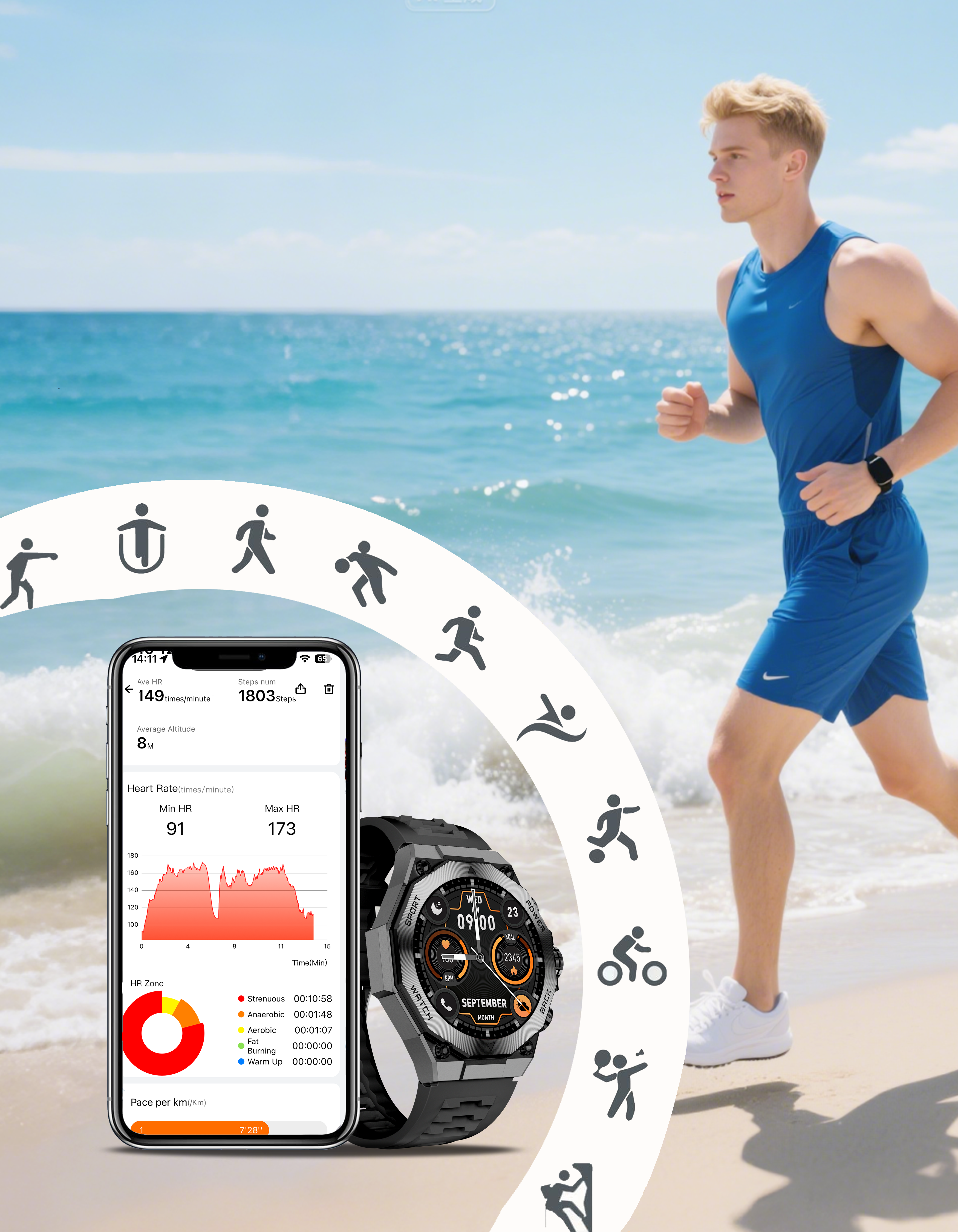
In real-world hiking tests the Trek 1 shines where it matters: consistent GPS tracks, a readable display in bright sun, and easy-to-navigate activity controls.
GPS accuracy — Standalone GPS keeps tracks tight on ridgelines and modest tree cover. You’ll occasionally see small deviations under dense canopy (as with most wrist-based systems), but overall breadcrumb trails are reliable for route reconstruction.
Altimeter & barometer — Helpful for short-term elevation trends and weather-awareness. The barometer does a decent job flagging sudden pressure drops before storms, which is a practical safety feature on multi-hour trails.
Verdict: for day hikes and multi-day treks where you need durability and dependable navigation, Trek 1 delivers.
5 ATM water resistance means the Trek 1 handles heavy rain, river crossings, and showering without worry. In wet-weather tests:
Touchscreen responsiveness reduces slightly with water on the display, but the physical buttons keep control firm.
Speaker and microphone are water-resilient for short exposures; expect muted audio while submerged.
The watch dried quickly and showed no corrosion or moisture-related behavior on return.
Verdict: built to cope with real wet conditions — not a diving tool, but fully capable for rain and shallow water.
While optimized for outdoors, Trek 1 remains a comfortable daily driver:
Comfort & styling: The watch balances rugged looks with wearable size — it’s noticeable but not clunky.
Notifications & smart features: Notifications are clear and actionable; quick dismiss are present. It doesn’t replace a phone for heavy app interactions but handles short bursts of information well.
Battery in daily mode: With daily notifications and sleep tracking, you can expect multiple weeks between charges — a huge advantage compared to many smartwatch-first devices.
Verdict: a great hybrid — outdoors-first but friendly enough for everyday life.
Battery life is a core differentiator in the rugged watch category, and Trek 1 intentionally emphasizes longevity.
Real numbers you’ll care about
Typical mixed use: 14–21 days (GPS occasionally, daily notifications, sleep tracking). This makes Trek 1 ideal for weekend adventures and longer trips without a charger.
Continuous GPS mode: Expect significantly reduced runtime (roughly 18–36 hours depending on settings), which is on par with similar multi-band GPS watches.
Standby mode: If you switch to ultra-power-saving modes (time + basic sensors), the watch can last multiple weeks.
Charging
Trek 1 supports relatively fast top-ups: roughly half charge in ~50 minutes, and a full charge within 120 minutes on standard charger. That’s plenty for travelers who need a quick boost before a day out.
The charging method is magnetic and secure — it clips on firmly and won’t fall off during packing.
Practical advice
For multi-day hikes, charge to 100% before leaving and enable battery-saving GPS profiles (e.g., 1–2 second vs high-frequency logging) when you need the most uptime.
The combination of long baseline battery and decent fast charge gives a flexible user experience: you can go long without plugging in, and when you do, you recover useful runtime fast.
Value proposition
The Trek 1 is positioned as a value-first rugged device: it avoids paying premiums for features that most outdoor users don’t use daily (expensive ancillary sensors, large app stores, or glossy consumer UIs).
You get the essentials: strong GPS, solid build, useful outdoor sensors (altimeter, barometer, compass), and long battery life — all of which add up to a watch you can rely on in the field.
Warranty & support
AuraFit typically backs its watches with a manufacturer warranty covering defects in materials and workmanship — check local terms for exact duration (many regions offer 12 months as standard; some tiers include extended options).
Practical support — downloadable firmware updates, activity sync through AuraFit’s companion app, and a straightforward repair/replacement path — increases long-term value.
Total cost of ownership
Because the Trek 1 focuses on longevity and repairability rather than planned obsolescence, its total cost of ownership is attractive: fewer replacements, fewer worries about fragile components, and enough performance for most outdoor users.
Why: Best mix of battery life, ruggedness, and price. Ideal for hikers, outdoors-first users, and buyers seeking dependable performance without premium price tags.
Who it fits: Weekend adventurers, serious hobbyists, and those who prefer function over fashion.
Ready to explore? Get your Trek 1 today
Why: Building on the same rugged DNA as the Trek 1, the AuraFit Trek 2 upgrades the experience with enhanced sensors, and extended battery life — all wrapped in a sleeker, more executive-ready design. It’s a smartwatch that performs as well in boardrooms as it does on mountain trails.
Who it fits: Ideal for business travelers, outdoor professionals, and tech-savvy users who want both durability and sophistication — a watch tough enough for the field, yet refined enough for daily meetings and urban wear.
Built for leaders and explorers — get yours today.
Why: ENERGY3 aims to give you the essentials at a lower price. It sacrifices some sensor sophistication and battery length but is an excellent entry point.
Who it fits: Casual hikers, budget-conscious buyers, or those who want rugged looks with basic functionality.
Tough gear, smart price — grab ENERGY 3 now
Why: NEXA 4 targets buyers who want premium materials, a sleeker look, and a more polished software experience — at the cost of some battery longevity.
Who it fits: Buyers who split their time between the office and the trail, and who care about style and app ecosystem as much as durability.
From office to outdoors — shop NEXA 4 today
In 2025 the rugged-watch space is broad enough that the right pick depends on priorities. If your primary need is a watch that won’t let you down when the weather turns and the trail climbs, AuraFit Trek 1 is an outstanding, pragmatic choice. It doesn’t try to be everything to everyone — instead it nails the essentials: reliable GPS, robust build, and truly long battery life.
Want more sensors and longer battery? Consider the Trek 2. Want to save money and still get a waterproof, rugged watch? ENERGY3 is worth a look. Craving a premium finish and a more conventional smartwatch UX? NEXA 4 rounds out the list.
✅ Resumidamente:
A classificação IP68 é um código de proteção de entrada padronizado definido pela Comissão Eletrotécnica Internacional (IEC). Veja o que significa:
No entanto, observe que o IP68 é testado em condições de laboratório usando água parada e fresca. Fatores do mundo real, como pressão da água, movimento, temperatura e contaminantes (e.g., sal ou sabão) podem afetar o desempenho. Por exemplo:
Embora o IP68 seja robusto, ele pode não cobrir todos os cenários extremos:
Com base em suas necessidades:
IP68 é suficiente para caminhadas e chuva forte, pois protege contra poeira, chuva e submersão acidental. No entanto, se suas atividades incluem natação, mergulho ou exposição à água de alta pressão, opte por um relógio com Classificação de 5 ATM ou superior. Sempre verifique as instruções do fabricante para garantir a longevidade.
✅ Regra prática:
Um smartwatch robusto deve durar confortavelmente pelo menos 1–2 semanas por carga em uso normal, e vários dias no modo GPS. Qualquer coisa menos que isso e ele estará mais próximo de um smartwatch “normal” disfarçado.
👉 Se você usá-lo com um terno, um smartwatch comum ou híbrido pode parecer mais elegante. Mas para estilos casuais/esportivos, relógios robustos são cada vez mais versáteis.
👉 A maioria dos smartwatches robustos agora são confortáveis o suficiente para uso diário, mas se você tem um pulso menor, pode notar o volume em comparação a um smartwatch fino e comum.

Compartilhar:
Long Battery Life Smartwatches You Can Rely On
Aurafit on Canadian TV Shopping: A Full Showcase of NEXA 4 & Ella 4